AI Agents in 2026: From Gimmick to Game-Changer
For three years, AI agents were a punchline. Demos looked impressive. Production results were embarrassing. Companies spent millions deploying agents that couldn’t reliably complete a ten-minute task without hallucinating, losing context, or quietly failing.
Then something changed. Not gradually. Abruptly.
In December 2025, multiple independent observers reported the same thing: AI agents, specifically coding agents, crossed a reliability threshold. They could hold complex tasks in memory. Recover from errors. Iterate on failures. Work autonomously for extended stretches without falling apart. The word that kept coming up was “coherence.”
At OpenClaw.rocks, we run personal AI agents for thousands of users. We’ve watched this space closely for years. What follows is our analysis of what happened, why software development was the first domain to flip, and what the trajectory of agentic AI means for every professional.
Why AI agents became reliable
December 2025 was not a single breakthrough. Two things converged.
Models crossed a quality threshold. Claude Opus 4.5, GPT-5.2, and Gemini 3 Pro all shipped within weeks of each other. Each brought a step-change in long-context coherence: the ability to track a complex task across thousands of tokens, reason about edge cases, and recover from dead ends without losing the thread. Earlier models could generate code snippets. These models could hold an entire project in their head, hit a wall, research a solution, backtrack, and try a different approach. That is the difference between autocomplete and an agent.
Tools learned to use the computer. Claude Code, Cursor, and OpenAI Codex don’t just suggest code. They read your files, run your tests, execute shell commands, interpret errors, and edit your codebase directly. They operate your development environment the way a developer would, except they don’t get tired and they don’t lose context across a 30-minute debugging session.
The combination of smarter models and tools that can act on the real world is what crossed the threshold. 84% of developers now use AI tools, with 51% using them daily. The market reflects it: Claude Code hit $1B in annualized revenue within six months of launch and doubled to $2.5B by February 2026. The $4B coding AI market now has three players above $1B ARR (GitHub Copilot, Claude Code, Cursor), holding 70%+ combined market share.
AI agent benchmarks: a new Moore’s Law
The shift is not just anecdotal. Researchers at METR have built the leading AI agent benchmark, testing agents on approximately 230 real-world tasks since 2019. Their finding: the length of tasks agents can reliably complete is doubling every seven months. In the most recent data from 2024 to 2025, that pace accelerated to doubling every four months.
The correlation between task length and agent success rate is remarkably clean (R² = 0.83), and the trend shows no sign of plateauing:
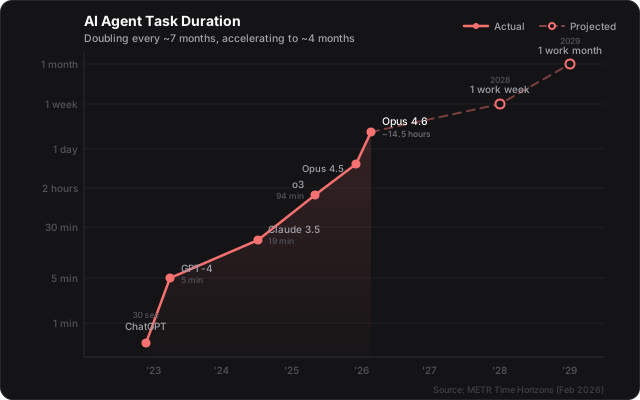
From 30-second tasks in 2022 to 14.5 hours with Claude Opus 4.6 in February 2026. The original METR trendline projected agents would handle an 8-hour workday by 2027. That milestone was hit a year early.
Anthropic’s production data shows the same acceleration from a different angle. Among the longest-running Claude Code sessions, the 99.9th percentile turn duration nearly doubled between October 2025 and January 2026: from under 25 minutes to over 45 minutes of uninterrupted autonomous work. Growth is smooth across model releases, not a sudden jump.
If the current doubling rate holds, METR projects agents will handle a 40-hour work week by 2028 and a work month by 2029. These are not idle forecasts. They sit on a trendline with six years of data, and the latest data point already outpaced the projection.
Why AI coding agents worked first
There is a reason AI coding agents work before other agents do. Software has structural properties that make it uniquely suited for autonomous AI systems.
Outputs are verifiable. Code compiles or it doesn’t. Tests pass or they fail. Types check or they throw errors. This gives agents a tight feedback loop for self-correction. No other professional domain has such clear, automated validation of output quality.
Specifications map to prompts. Software development already had the practice of writing requirements, acceptance criteria, and test cases. These translate directly into agent instructions. A specification is essentially a structured prompt.
Infrastructure for validation already exists. Git, CI/CD pipelines, linters, type checkers, test frameworks: agents plug directly into decades of tooling. No new infrastructure needed.
Everything stays digital. Code is text. Agents don’t need to interact with the physical world. The entire input/output chain is digital, deterministic, and auditable.
These properties create a virtuous cycle: agents attempt work, get immediate feedback, correct course, and improve. This is why coding agents crossed the reliability threshold first. Dario Amodei, CEO of Anthropic, went as far as predicting at Davos in January 2026 that AI will handle most software engineering tasks within six to twelve months.
But the important insight is not about coding. It’s about the pattern. Any domain that builds verifiable outputs, clear specifications, and automated feedback loops will follow the same trajectory.
AI agents for business: beyond coding
Design, infrastructure, finance, and marketing are building those feedback loops right now.
Design. Figma partnered with Anthropic in February 2026 to bridge AI coding tools and their design platform. Build a working interface by prompting an agent, then import it directly into Figma for refinement. The feedback loop between design intent and working code is tightening to minutes.
Infrastructure. Self-healing Kubernetes clusters are moving from research to production. AI agents continuously scan workloads, detect failures like CrashLoopBackOff or OOMKilled, collect logs, diagnose root causes, and apply fixes autonomously. They learn: the first time an agent encounters an OOMKilled pod, it might try a conservative memory increase and fail. The second time, it goes straight to the right allocation. The feedback loop is automated monitoring. The verification is system health.
Finance. Goldman Sachs is using Claude agents for trade accounting and client onboarding in production. Not a pilot. Real transactions. The feedback loop is regulatory compliance and reconciliation. Goldman’s CIO describes the shift as moving from “deploying human-centric staff to tackle tasks” to “deploying human-orchestrated fleets of specialized multi-agent teams.”
Marketing. AI SEO agents now monitor rankings, identify optimization opportunities, and execute changes. The feedback loop is search console data. One documented workflow achieved a 28% click increase within seven days by connecting an agent to Google Search Console and letting it optimize automatically.
The pattern is consistent. The moment a domain creates a tight feedback loop between agent action and measurable outcome, agents start delivering real value. And every major industry is now building those loops.
From vibe coding to agentic engineering
The industry is in the middle of a vocabulary change that reveals a deeper structural shift.
In February 2025, Andrej Karpathy coined the term “vibe coding”: the playful, experimental use of AI to generate code without scrutinizing it deeply. Exactly one year later, he replaced it with “agentic engineering”: disciplined, human-supervised agent orchestration where you define outcomes and agents handle execution.
The distinction matters because it mirrors what happens in every domain as agents mature. Phase one is novelty: people experiment, marvel at demos, produce unreviewed output. Phase two is professionalization: people develop workflows, establish quality gates, and treat agent output like they would treat a junior employee’s work. Review it. Test it. Own it.
The realistic productivity gain today is around 1.5x, not the 10x that hype cycles promise. But 1.5x sustained across an entire profession is enormous. And that gain goes disproportionately to people with domain expertise. Agents need good context to produce good output, and determining the right context requires deep understanding of the problem. This is why expertise becomes more valuable in an agent-driven world, not less. The person who knows what to build and can evaluate the result will always outperform the person who just knows how to prompt.
The personal AI agent is next
Goldman Sachs predicts 2026 is the year personal AI agents arrive. Their example: when a flight gets cancelled, your agent automatically rebooks, reschedules your meetings, and handles downstream logistics. All without you doing anything.
Gartner estimates 40% of enterprise applications will include task-specific AI agents by the end of 2026, up from less than 5% in 2025. The AI agents market is projected to grow from $12-15 billion in 2025 to $80-100 billion by 2030.
The signals are not just in analyst reports. OpenAI hired Peter Steinberger, the creator of OpenClaw, in February 2026 to build “the next generation of personal agents.” Steinberger had been shipping like a full team for months, solo, by centering his workflow entirely around AI agents. That is the pattern that will scale beyond developers: a single person, amplified by agents, accomplishing what previously required a team.
A mechanical engineer recently described building functional software for the first time using coding agents. A parent demonstrated how a single prompt created a working browser game at their 10-year-old’s school. These are early signals of what happens when agent capability reaches non-technical users.
The trajectory from the METR data is clear. Today’s agents handle tasks measured in hours. By 2028, they will handle tasks measured in weeks. That is not enough time to wait and see. It is enough time to start building fluency.
What this means in practice
For professionals watching this shift, three things matter:
The leverage is real, but it requires expertise. Agents amplify what you already know. A marketing executive who understands customer psychology will get more from an agent than someone who just asks it to “write some ads.” Deep domain knowledge becomes the bottleneck, and the advantage.
Agents are moving from reactive to persistent. Today’s AI tools are mostly reactive: open an app, type a prompt, get a response, close the app. The next wave runs in the background. Monitoring. Planning. Acting on your behalf across your communication channels and work systems. The difference between an AI agent and a chatbot is the difference between a tool and a teammate.
You shouldn’t have to babysit your agent. The current generation of AI tools requires you to open an app, start a session, and manage the interaction yourself. A real personal agent runs in the background, always available, always up to date, and always secure. That means someone needs to handle the infrastructure, the updates, the uptime, and the security so you can focus on actually using it.
That is what OpenClaw.rocks does. We give you a personal AI agent that runs 24/7 on your favorite messaging platforms: Telegram, WhatsApp, Discord, Signal. We handle the infrastructure, security, and updates. You just talk to your agent. It is built on OpenClaw, the open-source agent framework, so there is no vendor lock-in and your data stays yours.
The shift from gimmick to game-changer already happened in software. It is happening in design, finance, and infrastructure right now. Personal productivity is next.
The best time to start was December. The second best time is today.